November 2026 · Battery & electrical
How to Find the Right Battery Replacement
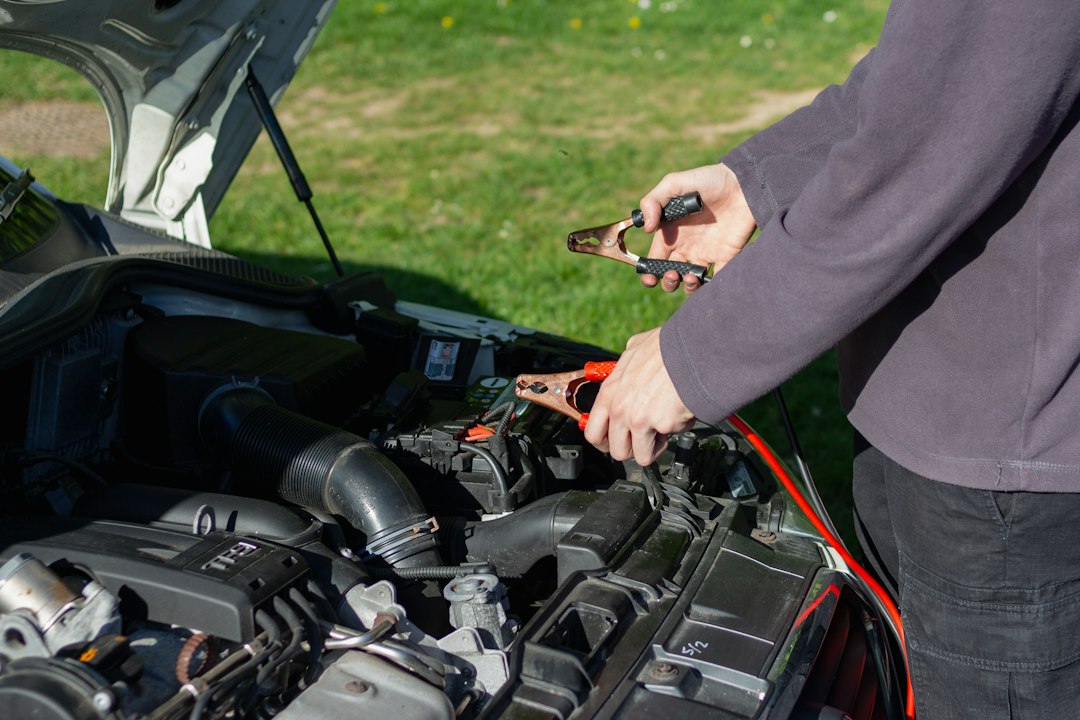
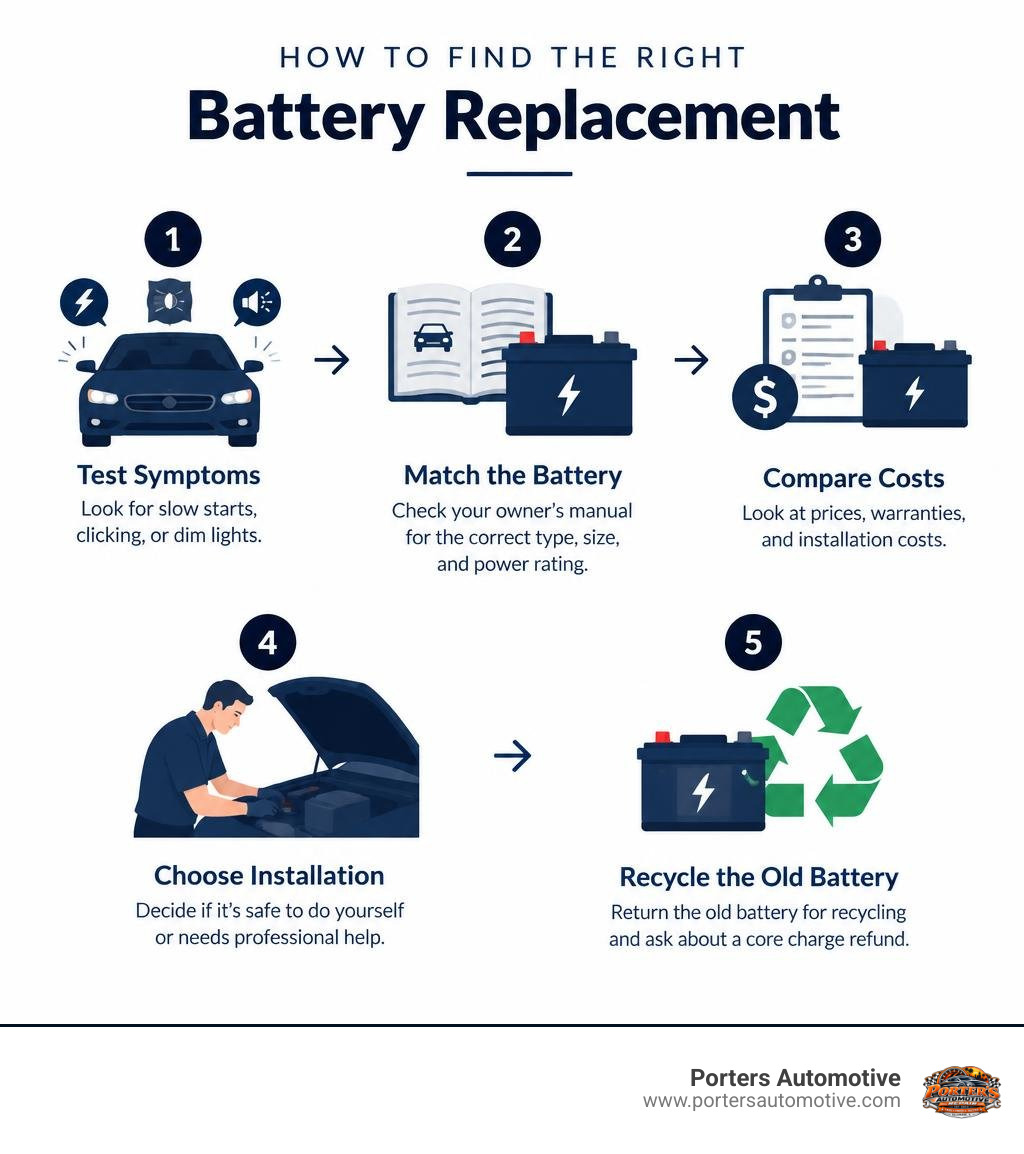
Start with a battery test, not a guess. To find the right battery replacement, follow five steps:
- Watch for slow starts, clicking, or dim lights.
- Check your owner's manual for the correct battery type, size, and power rating.
- Compare battery prices, warranties, and installation costs.
- Decide whether installation is safe to do yourself or calls for professional help.
- Return the old battery for recycling and ask about a core charge refund.
Most car batteries last three to five years, but heat can shorten that span. A key fob battery is a different job, and a hybrid's high-voltage battery needs a trained professional.
I'm Heath Porter, owner of Porters Automotive in Tallahassee. I've worked in automotive service since 2006, and I use that experience to help drivers make practical battery replacement decisions.
Step 1: Recognize the Warning Signs of Battery Failure
A failing battery rarely quits without dropping a few hints first. Catching these early warnings saves you from being stranded in your driveway before work or in a busy parking lot.
Keep an eye and ear open for these eight common symptoms of a weak or dying battery:
- Slow Engine Crank: When you turn the ignition key or press the start button, the engine turns over sluggishly, sounding strained or taking several seconds longer than usual to catch.
- Rapid Clicking Sounds: If you turn the key and hear a rapid click-click-click without the engine cranking, the battery has enough charge to trip the starter solenoid but lacks the amperage to turn over the starter motor.
- Dim Headlights and Interior Lights: Weak output from headlights, flickering dashboard displays, or slow power windows—especially when the engine is idling—point to voltage drop across the system.
- Swollen or Bulging Battery Casing: Extreme under-hood temperatures or excessive internal gas buildup can cause the flat sides of the plastic casing to swell outward. A bloated battery has suffered internal structural damage and must be replaced immediately.
- Rotten Egg or Sulfur Odor: A distinct sulfur smell around the engine bay signals that the battery is venting gas from an internal short or overcharging condition.
- Illuminated Dashboard Warning Lights: The battery dashboard icon or check engine light may illuminate when onboard sensors detect erratic charging system voltage.
- Frequent Need for Jump-Starts: If you find yourself pulling out jumper cables more than once a week, the battery can no longer hold a stable charge under normal operating conditions.
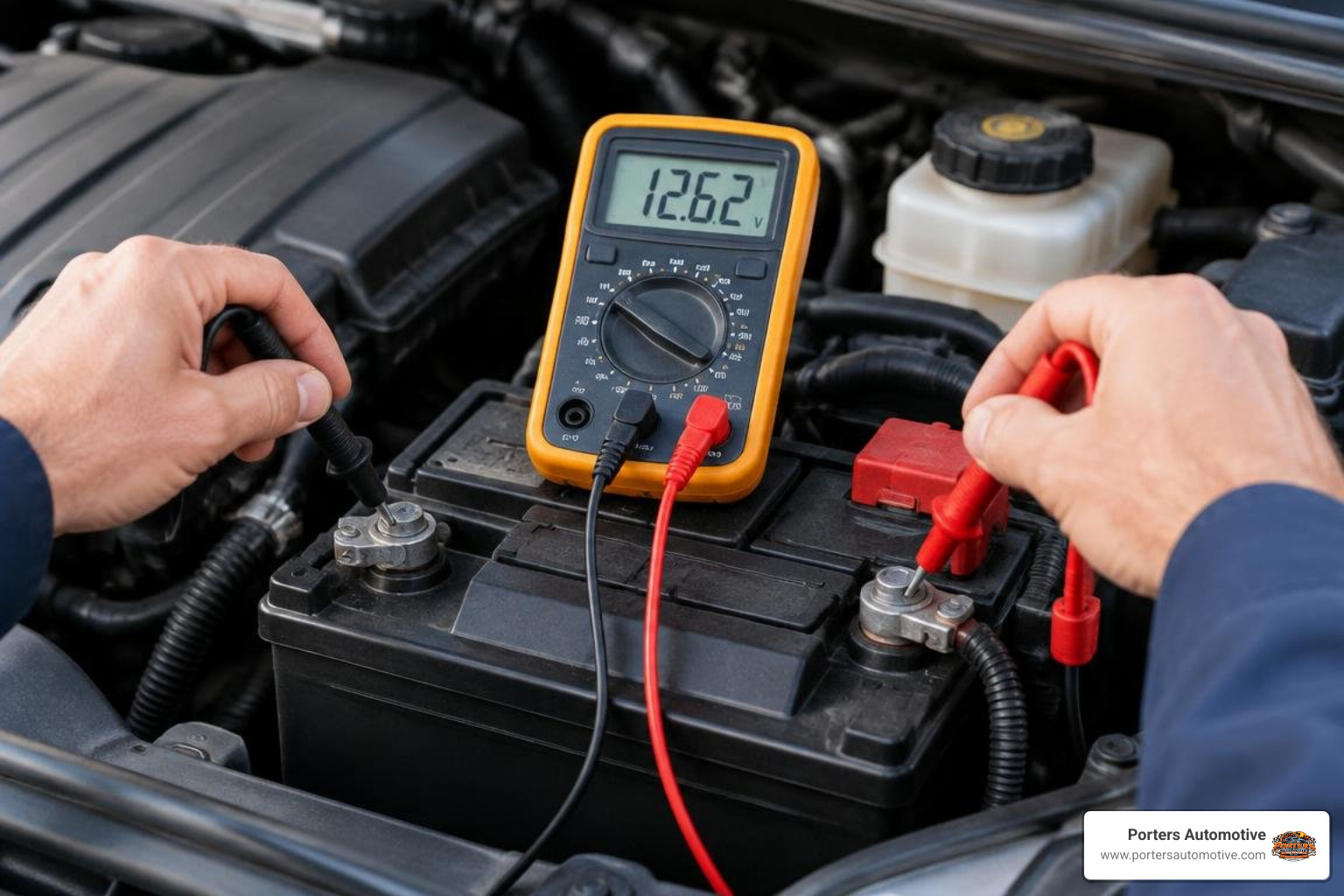
- Resting Voltage Below 12.4 Volts: A healthy, fully charged 12-volt battery measures around 12.6 volts at rest. When resting voltage drops below 12.4 volts, the battery is operating in a weakened state; dropping below 11.8 volts indicates that the battery has lost roughly 75% of its usable capacity.
Step 2: Choose the Right Battery Replacement for Your Vehicle
Not every battery fits under every hood. Selecting the wrong size or power rating can damage your vehicle's sensitive electrical systems or leave you stranded on cold mornings. Consult a reputable resource like the Best Car Battery Buying Guide - Consumer Reports or your vehicle owner's manual before buying.
When selecting a replacement unit, evaluate these core specifications:
- BCI Group Size: The Battery Council International (BCI) assigns standardized group numbers (such as Group 24F, 35, 48, or 94R) based on physical length, width, height, and terminal post positioning. Matching the correct group size ensures the unit fits snugly into the mounting tray and that the cables reach the posts without stretching.
- Cold Cranking Amps (CCA): CCA measures the current (in amperes) a battery delivers for 30 seconds at 0°F without dropping below 7.2 volts. Always match or slightly exceed the minimum CCA rating specified by your vehicle manufacturer.
- Reserve Capacity (RC): Reserve capacity indicates how many minutes a fully charged battery can run essential vehicle accessories if the alternator fails. High-performing batteries provide 90 to 120 minutes or more of reserve power.
- Battery Freshness and Date Codes: Lead-acid batteries degrade while sitting uncharged on store shelves. Check the date code stamped on the top or side label (for example, "10/26" or "K-6," indicating production in October 2026). Always purchase a unit manufactured within the last three to six months.
Comparing Standard Flooded and AGM Battery Replacement
Modern passenger vehicles rely primarily on two battery chemistries: traditional flooded lead-acid and Absorbent Glass Mat (AGM).
Standard flooded lead-acid batteries use lead plates submerged in liquid electrolyte. They remain cost-effective and reliable for older vehicles with basic electrical configurations.
In contrast, AGM batteries suspend electrolyte in ultra-thin fiberglass mats sandwiched between tightly packed plates. This sealed construction makes AGM units spill-proof, vibration-resistant, and capable of recharging up to five times faster than standard batteries.
Vehicles equipped with automatic engine stop-start technology, regenerative braking systems, or high-draw electronic accessories demand AGM units to survive frequent deep discharge cycles.
| Feature | Standard Flooded Lead-Acid | Absorbent Glass Mat (AGM) |
|---|---|---|
| Typical Cost | $45 – $150 | $100 – $250+ |
| Vibration Resistance | Moderate | Superior |
| Deep Cycling Tolerance | Fair (sensitive to deep discharge) | Excellent (handles deep cycling) |
| Recharge Speed | Standard | Up to 5x Faster |
| Spill & Leak Resistance | Vent caps present; liquid electrolyte | Fully sealed; spill-proof glass mat |
| Best Application | Conventional vehicles with basic electronics | Start-stop vehicles, high-draw accessories |
Key Factors That Impact Car Battery Longevity
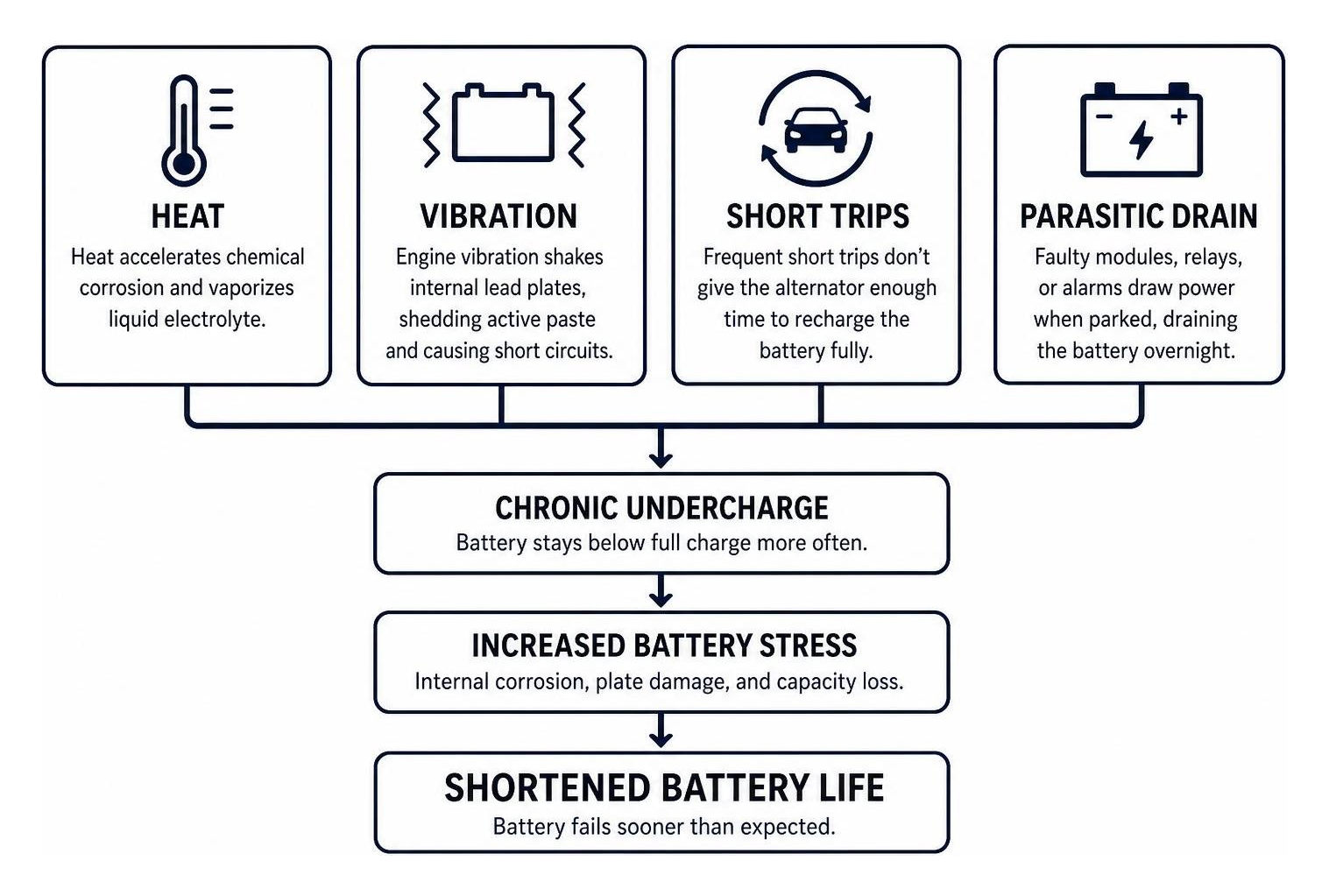
While standard passenger vehicle batteries carry an average lifespan of three to five years, your local driving environment plays a massive role in actual service life:
- Under-Hood Heat: Heat accelerates chemical corrosion inside the battery casing and vaporizes liquid electrolyte. Under-hood temperatures often surpass 200°F during hot Florida summers. In warm southern locales like Tallahassee, Quincy, and Bradfordville, batteries regularly degrade within three years, whereas vehicles in cooler northern states may see five or more years of service.
- Vibration Damage: Loose hold-down clamps allow engine vibration and road impact to shake internal lead plates, shedding active paste and creating internal short circuits.
- Frequent Short Trips: Starting the engine consumes substantial battery reserve. Driving for only five or ten minutes does not give the alternator enough runtime to restore that spent energy, leaving the battery perpetually undercharged.
- Parasitic Electrical Drain: Faulty body modules, stuck interior relays, or aftermarket alarms can draw continuous current when the vehicle is parked, draining the battery below critical thresholds overnight.
- Specialty Vehicle Demands: Recreational vehicles and deep-cycle systems face unique power draws that differ from standard daily commuters; learn how to Find the Right RV Battery Replacement Before You Buy to protect deep-cycle equipment from premature failure.
Step 3 & 4: Compare Professional Service vs. DIY Installation
Deciding whether to install your new battery at home or let a professional handle it comes down to vehicle layout, tools, and safety considerations.
Across the industry, standalone replacement batteries range from $45 to $250 depending on chemistry and group size. When factoring in professional diagnostic scans, system registration, and labor, the total average cost for complete installation typically ranges between $456 and $493, with professional labor commonly running $61 to $90.
| Consideration | DIY Battery Installation | Professional Shop Installation |
|---|---|---|
| Total Cost | Parts only ($45 – $250) | Parts + diagnostic labor ($456 – $493 average) |
| Diagnostic Scope | Basic voltage check (if you own a meter) | Complete starting, charging, & alternator analysis |
| Computer Safety | Risk of memory loss or ECU reset | Memory saver tool used; BMS reset & coded |
| Accessibility | Limited to standard engine bay mounts | Equipped for trunk, seat, or wheel well disassembly |
| Disposal | You must transport the core to a retailer | Old battery safely recycled on-site |
Modern vehicles often place batteries in challenging locations—such as underneath the front passenger seat, tucked inside the trunk liner, or buried behind the front wheel well splash shield. Furthermore, many modern European and domestic vehicles require the onboard Battery Management System (BMS) to be recalibrated using a diagnostic scan tool so the alternator does not overcharge the new battery. If your vehicle requires battery registration or complex disassembly, scheduling professional service is the safest choice.
Step-by-Step Instructions for DIY Battery Replacement
If your battery is easily accessible in the engine bay and you feel comfortable handling automotive tools, you can complete the replacement at home by following this sequence:

Essential Tools and Safety Gear:
- Safety glasses and heavy-duty nitrile or work gloves
- 10mm and 13mm box wrenches or a basic socket wrench set
- Battery terminal wire brush or post cleaning tool
- Baking soda and water solution (for neutralizing acid residue)
- Anti-corrosion washers and dielectric terminal grease
Procedure:
- Prep the Vehicle: Park on a level surface, engage the parking brake, switch off all vehicle electronics, and remove the key from the ignition to put the onboard computers to sleep.
- Disconnect the Negative (-) Terminal First: Loosen the nut on the black negative cable clamp with your wrench. Twist and gently lift the clamp off the terminal post. Tuck the cable safely to the side or cover it with a dry cloth so it cannot spring back and touch the terminal. Always remove the negative terminal first to avoid sparking if your metal wrench touches the vehicle frame.
- Disconnect the Positive (+) Terminal: Loosen and remove the red positive cable clamp from its post.
- Remove Hold-Down Hardware: Unbolt the hold-down bracket or retaining clamp securing the bottom or top of the battery case using a socket wrench.
- Extract the Old Battery: Carefully lift the battery straight up using its integrated carry handle. Automotive batteries weigh between 25 and 60 pounds, so lift with your legs and keep the battery upright.
- Clean the Mounting Area: Use a wire brush dipped in a baking soda and water mixture to scrub away white or greenish corrosion buildup from the tray and cable clamps. Wipe everything dry with a clean shop rag.
- Install the New Battery: Place the fresh battery into the tray in the exact orientation as the original, ensuring positive and negative posts line up with their respective cables. Reinstall and firmly tighten the hold-down bracket.
- Reconnect Terminals (Positive First, Negative Last): Slide anti-corrosion felt washers over the posts. Connect the positive (+) red cable clamp first, tightening the nut until snug. Next, connect the negative (-) black cable clamp last. Apply a thin coating of dielectric grease or protective battery spray to the terminals to seal out moisture.
- Test the Installation: Start the engine to verify smooth cranking, then check dashboard displays for warning lights.
You can also check the official guide on How to replace a car battery | The AA for more safety tips.
Safe Emergency Jump-Starting Procedures
If your battery goes flat unexpectedly, jump-starting can get you running so you can drive to a service shop. Remember: lead-acid batteries vent flammable hydrogen gas, so making the final ground connection away from the battery post is critical.
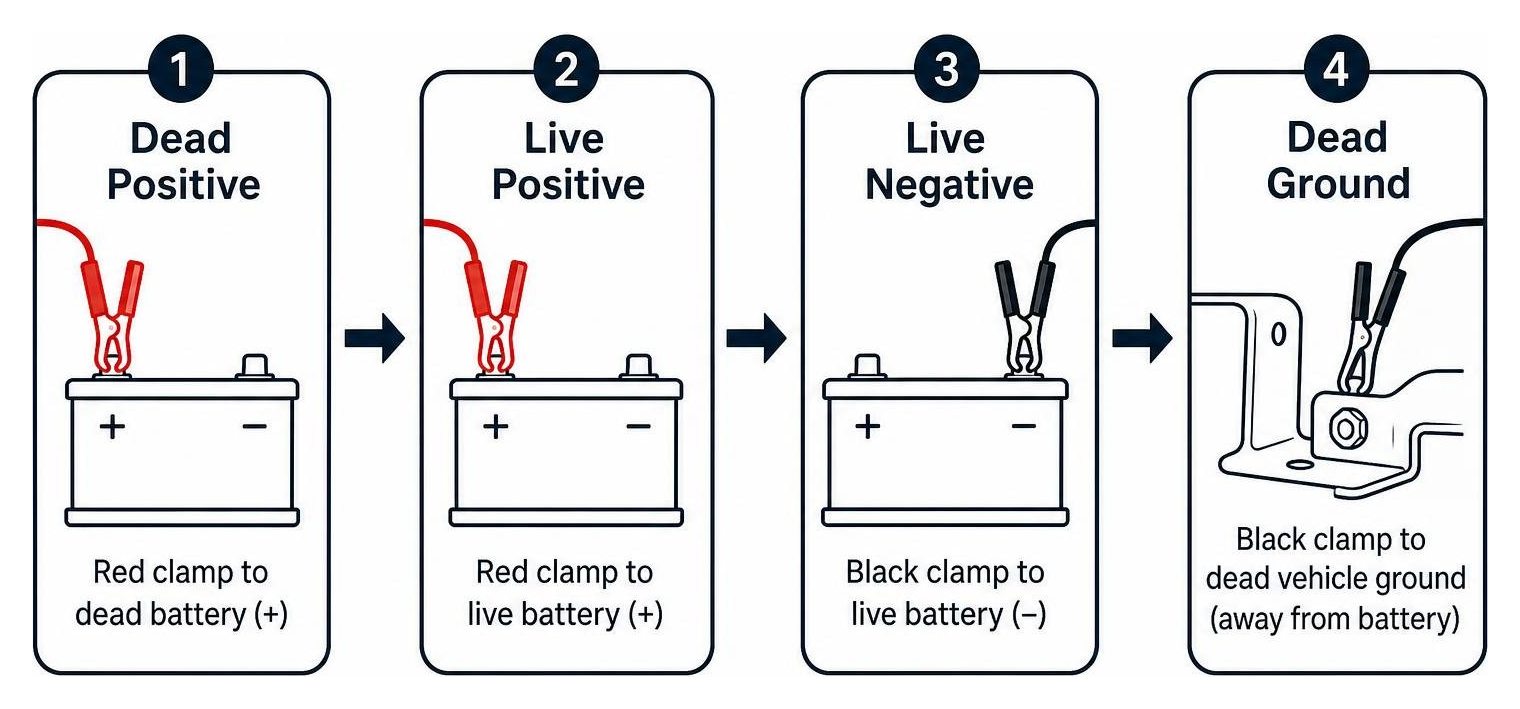
- Position the assisting vehicle close enough for the cables to reach, but make sure the two cars do not touch. Turn off both ignitions and set both parking brakes.
- Connect the first red positive clamp to the positive (+) post of the dead battery.
- Connect the second red positive clamp to the positive (+) post of the donor battery.
- Connect the first black negative clamp to the negative (-) post of the donor battery.
- Connect the second black negative clamp to an unpainted, solid metal engine bracket or chassis bolt on the disabled vehicle (away from the battery).
- Start the donor vehicle's engine and let it run at a high idle for approximately five minutes to transfer surface charge to the dead battery.
- Start the engine of the dead vehicle. Once it starts, let both cars idle for two minutes.
- Disconnect the cables in the exact reverse order: remove the unpainted metal ground clamp first, then the donor negative clamp, then the donor positive clamp, and finally the positive clamp from the newly started vehicle.
- Drive the vehicle continuously for at least 20 to 30 minutes to allow the alternator to recharge the battery.
Step 5: Handle Battery Recycling and Claim Your Core Charge
Automotive lead-acid batteries contain toxic lead plates and strong sulfuric acid, making them hazardous waste that should never be thrown into household trash.
Thankfully, automotive batteries represent one of the world's most successful environmental recycling loops—about 90 percent of car batteries are truly recycled.
When you purchase a replacement battery at an auto parts retailer, you will typically pay an extra "core deposit" fee (usually $10 to $25). When you bring your old battery back to the retailer, they refund that core charge and route the spent unit through certified closed-loop recycling channels, where the plastic casing is melted down, the acid is neutralized or repurposed, and the lead is smelted into new battery components.
Frequently Asked Questions About Car Batteries
How much does it cost to replace a car battery?
The cost of the battery itself ranges from $45 to $250 depending on whether it is a standard lead-acid or premium AGM unit. When installed by a certified automotive technician—including comprehensive starting and charging system diagnostics and onboard battery registration—the total average cost for parts and labor typically falls between $456 and $493.
How long does an automotive battery typically last?
A standard car battery lasts between three and five years under average driving conditions. In hot southern climates, sustained under-hood heat accelerates fluid evaporation and grid corrosion, often reducing battery life to around three years. In cooler northern regions, batteries frequently last five years or longer.
What should you do if your battery repeatedly dies?
If a relatively new battery keeps running flat, the problem likely stems from an alternator failure, high parasitic electrical draw from an accessory, or heavy terminal corrosion. Have a professional technician run a full diagnostic scan on the alternator, starter, and wiring circuits before spending money on another replacement unit.
Conclusion
A dependable battery is the heart of your vehicle's electrical system. Proactive maintenance—such as inspecting terminals for corrosion, checking battery date codes, and testing resting voltage annually once your battery hits three years of age—prevents unexpected breakdowns.
Whether you need a routine charging system check, starter analysis, or expert installation on a complex vehicle layout, we are here to help. Reach out to Heath Porter and the experienced team at Porters Automotive for professional automotive repair and diagnostic services across Tallahassee, Quincy, and Bradfordville.