November 2026 · Shop tips
Brake Booster Diaphragm Failure: What a Hard Pedal Can Mean
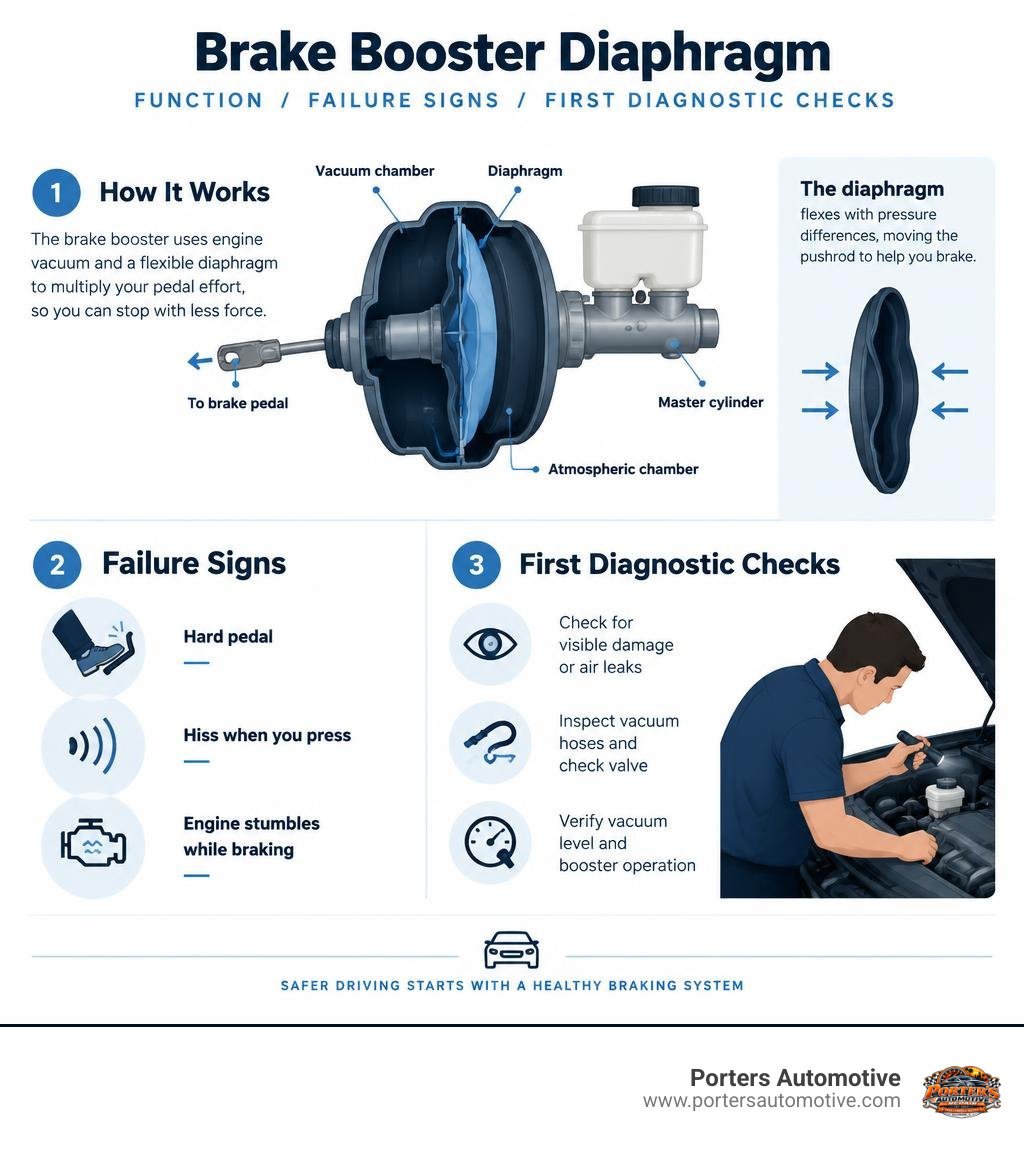
A hard brake pedal, a hiss when you press it, or an engine that stumbles while braking can point to brake booster diaphragm failure. The damaged diaphragm can let air into the booster and reduce power assist, so stopping takes more pedal force. These signs can also come from a bad vacuum hose or check valve. If braking feels harder than usual, stop driving and have the system checked.
I'm Heath Porter, owner of Porters Automotive. I've worked in automotive service since 2006, and I'll help you understand how to spot brake booster diaphragm failure and what a proper diagnosis involves.
What Is a Brake Booster Diaphragm and How Does It Work?
Under your vehicle's hood, bolted firmly against the firewall right behind the master cylinder, sits the brake booster. Its primary job is simple yet crucial: it multiplies the physical effort you apply to the brake pedal so you can stop a multi-ton vehicle with gentle foot pressure.
Inside the brake booster's metal canister lies the core of the entire vacuum-assist system: the brake booster diaphragm. This is a tough, flexible rubber membrane that divides the booster canister into two distinct pressure chambers:
- The constant vacuum chamber (facing the front of the vehicle, plumbed straight to a vacuum source).
- The working or atmospheric chamber (facing the vehicle interior and connected to the brake pedal pushrod).
Under normal operating conditions, a healthy vacuum brake booster normally lasts from 150,000 miles to the lifetime of the vehicle. When everything is sealed, the internal return spring keeps the internal components balanced until you call on them to stop.
The Critical Role of Vacuum Pressure in Power Braking
Vacuum power-assist relies entirely on the basic physics of atmospheric pressure differentials. A healthy gasoline engine draws an intake manifold vacuum ranging between 16 and 22 inches of mercury (inHg) at idle.
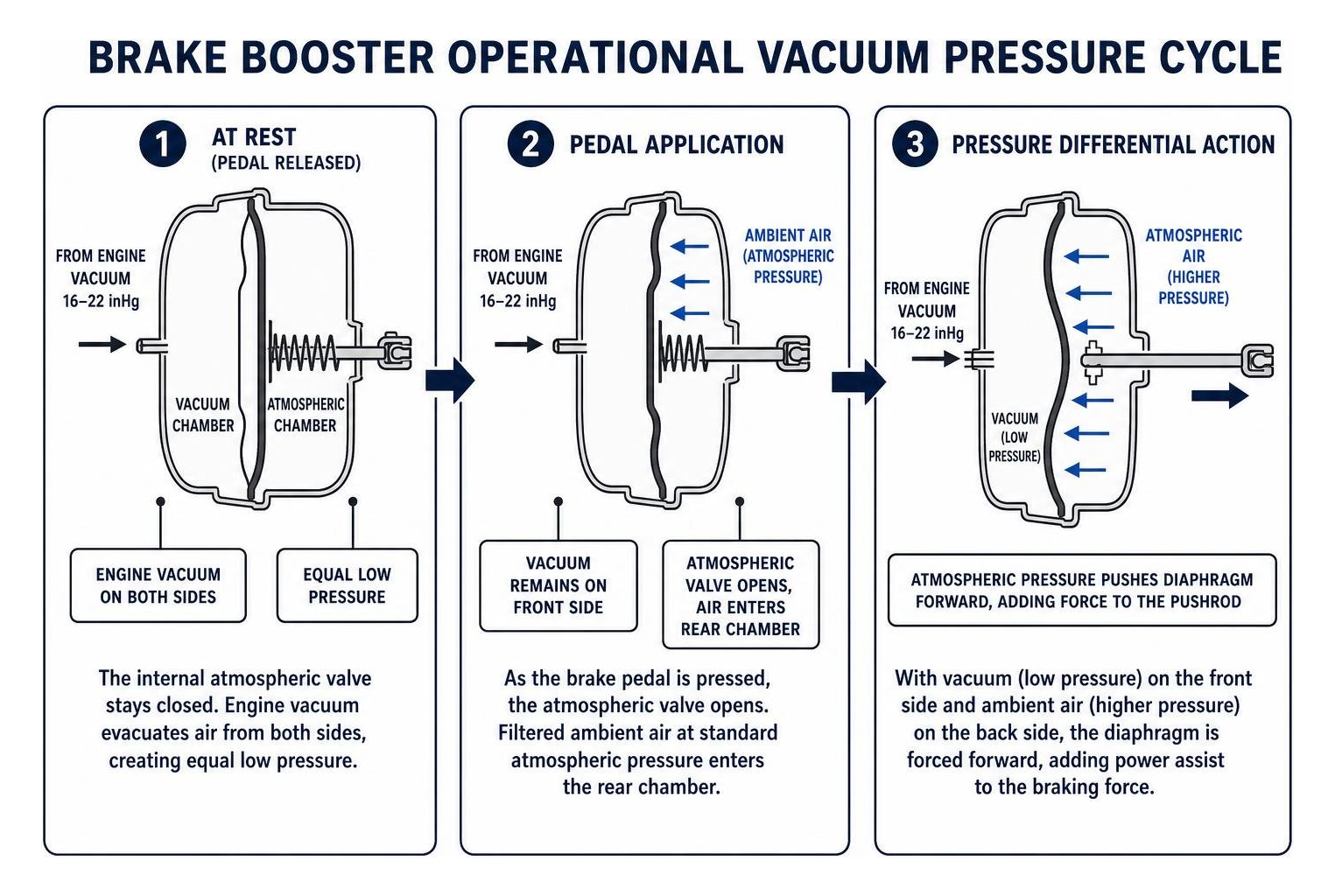
Here is how that engine vacuum translates into stopping force when you press the pedal:
- At Rest (Pedal Released): The internal atmospheric valve stays closed. Engine vacuum evacuates air from both sides of the flexible rubber membrane, creating an equal low-pressure state throughout the booster canister.
- Pedal Application: As your foot presses the brake pedal, the mechanical pushrod opens the atmospheric valve. This lets filtered ambient air at standard atmospheric pressure rush directly into the rear working chamber.
- Pressure Differential Action: With deep engine vacuum (low pressure) on the front side and ambient air (higher pressure) on the back side, the flexible diaphragm is forced forward.
- Force Multiplication: The diaphragm drives the central pushrod into the hydraulic master cylinder. This mechanical assistance multiplies your physical foot effort by up to four or five times, generating massive hydraulic pressure at the wheel calipers without requiring you to stand on the pedal.
When the booster diaphragm is healthy, this transfer of energy is instant, seamless, and completely silent. But when that rubber membrane tears or detaches, power braking quickly falls apart.
Primary Causes and Warning Signs of Brake Booster Diaphragm Failure
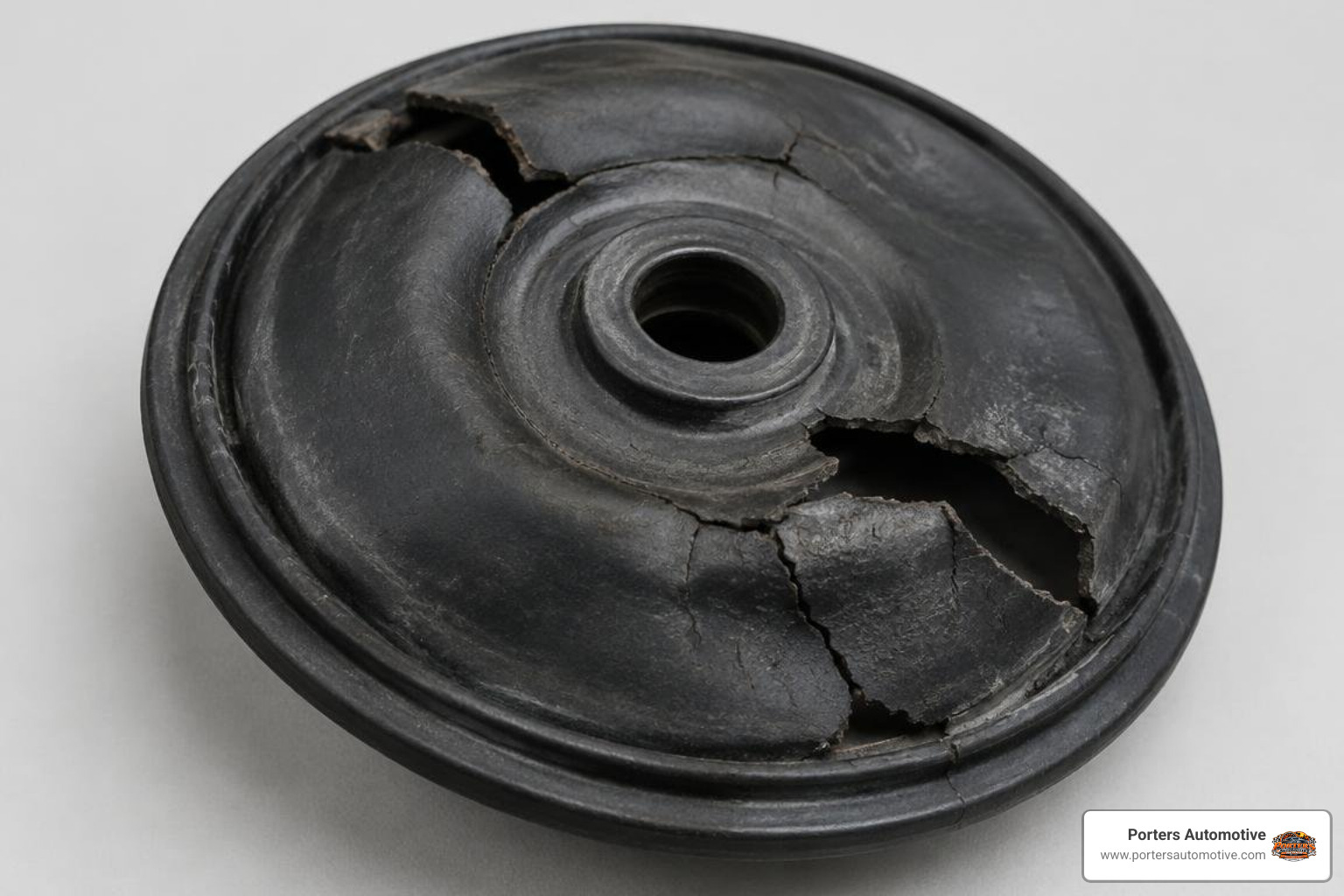
When an internal tear, pinhole, or displacement develops along the rubber membrane, air bleeds freely across the booster chambers. Instead of harnessing a pressure differential to push the master cylinder rod, engine vacuum pulls unmetered ambient air right through the torn diaphragm and into the engine intake manifold.
Before jumping straight to component replacement, it pays to rule out external issues. A quick review of our guide on Brake Booster Repair: Check the Simple Causes First can help you confirm whether you are dealing with a minor hose issue or an internal component failure.
Top Symptoms of Brake Booster Diaphragm Failure
Recognizing the warning signs early protects you from unexpected stopping trouble on the road:
- Rock-Hard Brake Pedal: The most direct symptom is a pedal that feels stiff, unyielding, and wooden. You will notice that stopping the car requires heavy, two-footed pressure because you are operating strictly on manual hydraulic force without any power assist.
- Audible Hissing or Whistling Noise: When you step down on the pedal, you might hear what sounds like air escaping under the dashboard or from the driver-side footwell. This hissing occurs as ambient air gets sucked across the torn internal rubber membrane.
- Engine Stumbling or Stalling at Stops: Because the booster connects directly to the intake manifold, stepping on the brakes with a ruptured diaphragm introduces a sudden rush of unmetered air into your engine. This vacuum leak throws off the air-fuel ratio, causing the engine idle to stumble, shake, or stall entirely when coming to a halt.
- Illuminated Check Engine Light (MIL/CEL): Modern powertrain control modules constantly monitor fuel trims. A substantial vacuum leak through a split brake booster diaphragm frequently logs diagnostic trouble codes such as P0171 or P0174 (indicating the engine bank is running too lean), or P050F (Brake Assist Vacuum Too Low).
- Increased Stopping Distances: Without vacuum assist, reaction times slow and the distance required to bring the car to a full stop grows significantly.
Root Causes: Fluid Contamination and Material Degradation
What causes a heavy-duty automotive diaphragm to fail? In our service bays, we find that booster failure generally traces back to four primary culprits:
- Brake Fluid Contamination: If the rear seal of the master cylinder begins leaking, corrosive brake fluid seeps directly into the front chamber of the booster. Brake fluid quickly attacks, softens, and degrades standard rubber compounds, causing the diaphragm to blister, tear, and disintegrate.
- Engine Oil Migration: In vehicles utilizing mechanical or camshaft-driven vacuum pumps, faulty internal check seals can allow engine oil to travel up the vacuum supply line. A notable real-world example occurred when roughly 105,400 vehicles were recalled under the NHTSA Brake Booster Contamination Recall for 2013–2014 Dodge Dart models equipped with 2.0L and 2.4L engines, where oil migration degraded the internal booster diaphragm and caused sudden assist loss.
- Manufacturing and Housing Defects: In some cases, improper assembly tolerances allow the diaphragm bead to unseat from its crimped metal shell. Hyundai issued service recalls covering this exact issue, as detailed in their Hyundai Service Bulletin on Diaphragm Defects and related dealer notices for the 2017 Elantra and 2023 Palisade, where unseated diaphragms allowed vacuum pressure to escape instantly.
- Age, Ozone, and Dry Heat Degradation: Over thousands of heat cycles and years of service, rubber components naturally dry out, lose their elasticity, and develop micro-cracks along flex points.
Step-by-Step Guide to Diagnosing a Faulty Brake Booster
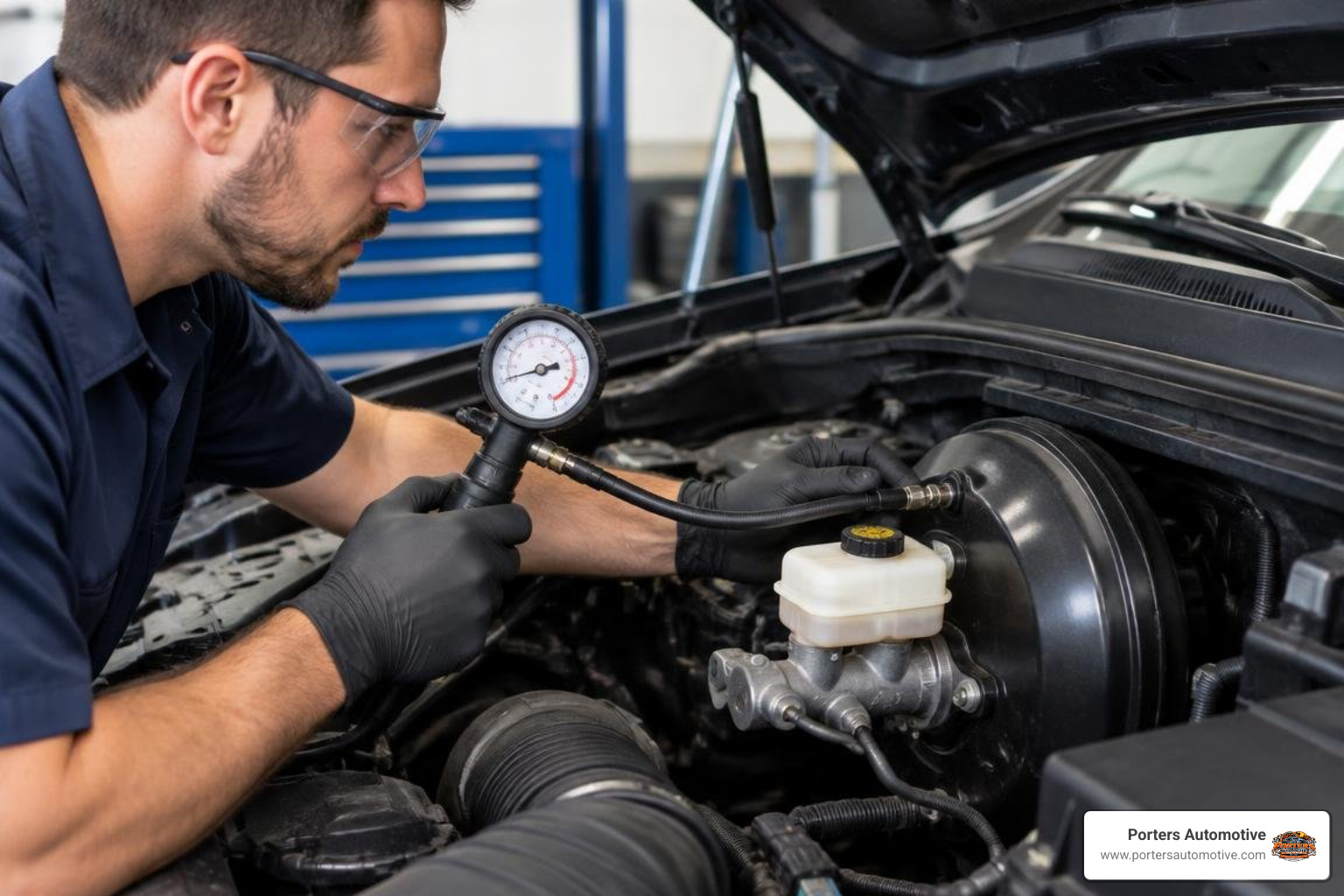
Diagnosing a brake booster problem involves isolating the booster canister itself from the engine's vacuum supply line, the one-way check valve, and the hydraulic brake lines.
As noted in the AutoRestorer brake booster vacuum leak analysis, even a tiny tear inside the booster housing can cause intermittent pedal drop followed by a rock-hard pedal fade as atmospheric air overtakes the vacuum chamber.
How to Test and Confirm Brake Booster Diaphragm Failure
You can perform several clear, practical tests right in your driveway or shop bay to verify booster health.
To confirm internal leakage conclusively, connect a manual vacuum gauge inline at the booster supply port. With the engine idling, verify that the vacuum supply registers between 16 and 22 inHg. Turn off the engine and watch the needle: a sealed booster should hold its vacuum steady for several minutes. If the gauge needle drops rapidly toward zero the moment the engine shuts off—or plunges when you press the brake pedal—the internal diaphragm is leaking.
Finally, spray soapy water along external vacuum fittings and hose connections while the engine idles. If the connections show no bubbling or fluid draw, but the hiss continues deep inside the housing whenever the pedal is applied, the internal diaphragm has failed.
Distinguishing a Bad Diaphragm from Check Valve and Hose Issues
Before condemning the entire booster assembly, make sure to isolate the supporting vacuum components:
- The One-Way Check Valve: Located at the booster canister vacuum inlet, this valve lets air escape toward the engine but prevents air from entering the booster when engine vacuum drops. A faulty check valve can stick open or closed. If you remove the valve and blow gently through it, air should pass freely in only one direction (from the booster toward the engine). Replacement check valves cost $15 to $50 for the part, with shop labor adding $100 to $250.
- Vacuum Supply Hose: A split, collapsed, or oil-softened vacuum hose mimics diaphragm failure by starving the booster of vacuum. Inspect the entire rubber and plastic line for cracks, loose hose clamps, or internal collapse.
- Hydraulic Faults vs. Booster Faults: A failing master cylinder or air trapped inside the hydraulic lines creates a spongy, soft, or sinking pedal. A failed brake booster diaphragm produces the exact opposite: a hard, high, unyielding pedal.
Repair vs. Replacement: Costs and Safety Considerations
When an internal diaphragm fails, vehicle owners often ask if the torn rubber membrane can simply be patched or replaced on its own.
The short answer is no. Modern vacuum brake boosters are factory-sealed units featuring heavy metal casings that are mechanically crimped and calibrated under extreme industrial spring tension. Disassembling a crimped booster housing is dangerous due to the compressed internal return spring, and aftermarket rebuild kits cannot guarantee the airtight factory seal required for critical safety components. For reliable operation and road safety, the complete brake booster assembly must be replaced.
| Repair Option | Typical Parts Cost | Typical Labor Cost | Total Estimated Cost | Notes & Feasibility |
|---|---|---|---|---|
| Brake Booster Check Valve | $15 – $50 | $100 – $250 | $115 – $300 | Easily serviceable external plastic valve |
| Booster Vacuum Supply Hose | $20 – $70 | $50 – $150 | $70 – $220 | Quick external line replacement |
| Complete Brake Booster Assembly | $150 – $600 | $250 – $400 | $500 – $1,200 | Industry standard for internal diaphragm failure |
| Vehicle-Specific (e.g., Nissan Frontier) | $681 – $688 | $254 – $373 | $936 – $1,061 | Factory OEM booster assembly replacement |
Realistic Cost Breakdown for Brake Booster Replacement
For a complete booster replacement, aftermarket parts generally run between $150 and $300, while specialized OEM units range from $400 to $600. Professional installation labor generally runs between $250 and $400, depending on firewall clearance, master cylinder layout, and whether the hydraulic brake lines require bleeding afterward.
This puts the total shop replacement cost between $500 and $1,200 for most passenger vehicles. For instance, replacing the brake booster on a popular midsize truck like a Nissan Frontier typically averages between $936 and $1,061, with parts accounting for roughly $681 to $688 and labor adding $254 to $373.
The Dangers of Driving with a Compromised Booster
Driving with a compromised brake booster diaphragm introduces severe safety risks:
- Sudden Loss of Stopping Power: Without power assist, stopping quickly requires immense leg strength. In an emergency panic-stop situation, you may simply not be able to generate enough pedal force in time.
- Significantly Longer Braking Distance: Even modest vacuum leaks can extend your stopping distance by up to 30%, drastically increasing the risk of a front-end or rear-end collision.
- Engine Stalls During Critical Turns and Stops: If the engine cuts out when you press the brake pedal at an intersection or while slowing down to turn, you lose both power braking and power steering assist simultaneously.
Frequently Asked Questions About Brake Booster Issues
Can a brake booster diaphragm be repaired?
No. Vacuum brake boosters are factory-crimped, sealed units built under high spring tension. Attempting to pry open the canister to patch or replace the rubber diaphragm is hazardous and compromises structural integrity. When a diaphragm cracks, tears, or unseats, the entire booster assembly must be replaced.
Why does my engine stall or stumble when I press the brake pedal?
Your brake booster draws vacuum directly from the engine intake manifold. When the internal diaphragm tears, pressing the brake pedal opens a path for unmetered ambient air to flood directly into the intake tract. This massive vacuum leak causes the air-fuel mixture to run excessively lean, making the engine stumble, shake, or stall out at idle.
Will a bad brake booster cause a spongy or sinking pedal?
No. A bad brake booster causes a stiff, hard brake pedal that requires heavy physical effort to depress. If your brake pedal feels spongy, soft, or slowly sinks all the way to the floorboard while waiting at a red light, the issue is almost certainly within the hydraulic system—such as air in the brake lines, a leaking caliper, or an internal master cylinder piston leak.
Conclusion
A firm, responsive brake pedal is essential for safe driving every time you get behind the wheel. If you notice a hissing sound when slowing down, an engine that stumbles at red lights, or a pedal that suddenly feels like a brick, your vehicle is signaling that its vacuum assist is compromised. Addressing a torn diaphragm promptly restores smooth stopping power and prevents engine driveability issues.
At Porters Automotive, our team is dedicated to providing thorough diagnostics, honest guidance, and reliable repairs to keep you and your family safe on the road. If your brakes are acting up or your pedal feels heavy, explore our professional brake diagnostic and repair services or visit us at our Tallahassee, Quincy, or Bradfordville locations to have your braking system inspected by our experienced technicians.
Safe travels,
Heath Porter
Owner, Porters Automotive