October 2026 · Shop tips
Automotive Air Conditioning Repair: Choose a Shop That Finds the Cause

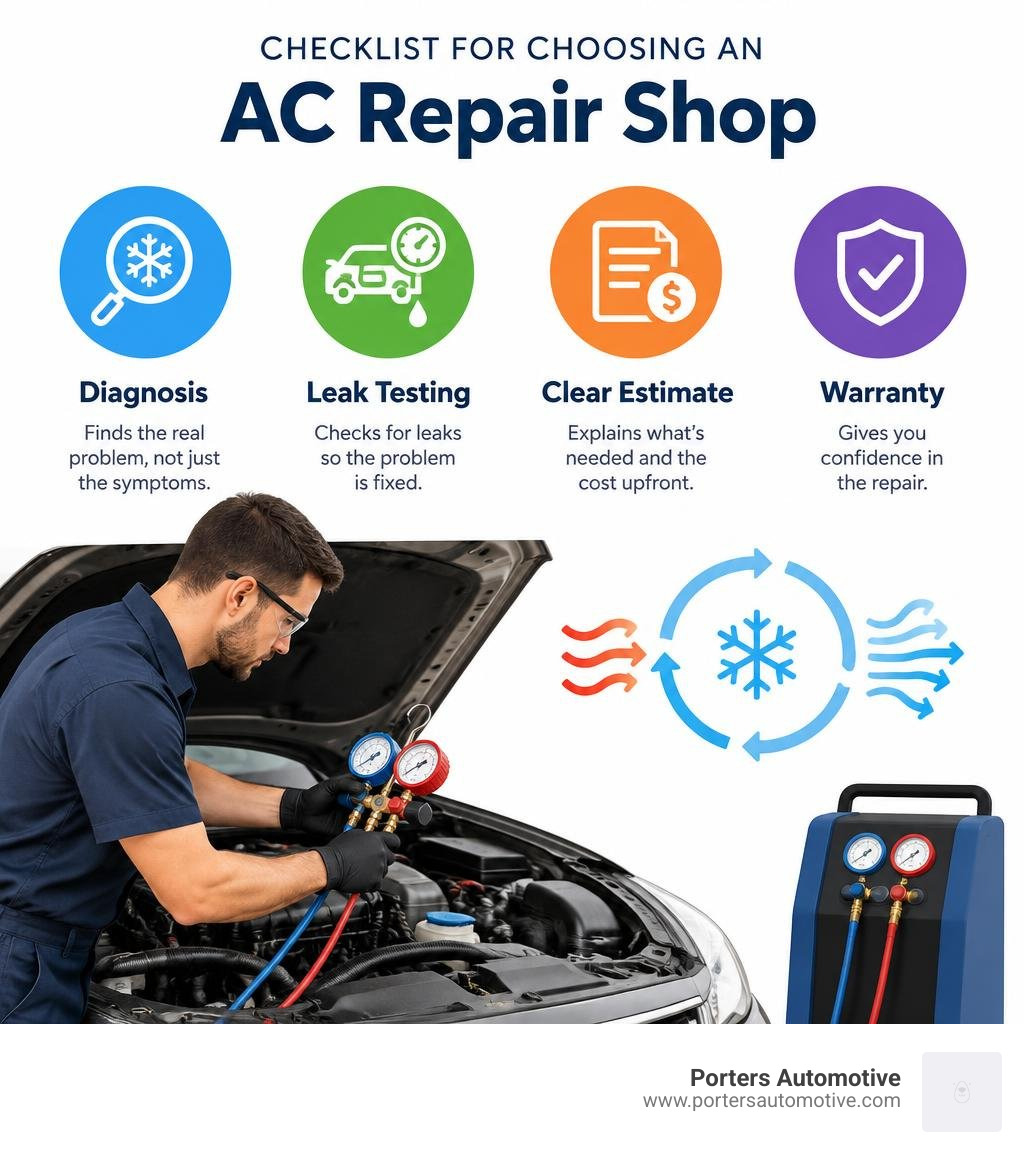
Choose a repair shop that diagnoses the problem before adding refrigerant. Ask whether it checks cooling performance, tests for leaks, inspects electrical parts, and gives you a clear estimate before work begins. A recharge may restore cooling, but if refrigerant is low because of a leak, adding more will not fix the cause.
Warm air, weak airflow, odd noises, or cooling that fades while you idle are good reasons to book a check. A shop that can explain what failed, what the repair includes, and what warranty applies can help you avoid paying for guesswork.
I'm Heath Porter, owner of Porters Automotive in Tallahassee. I've worked in automotive service since 2006, and I bring that hands-on approach to helping drivers make informed choices about automotive air conditioning repair.
How Vehicle Climate Control Works: Core Components and System Physics
Your vehicle's air conditioner does not actually create cold air. Instead, it extracts heat and humidity from the cabin air and releases that heat outside the vehicle. This process relies on a continuous thermodynamic loop that alters the pressure and physical state of a specialized chemical refrigerant. Most modern passenger cars and light trucks require a precise charge—typically between 28 and 32 ounces of refrigerant (roughly two to three 12-ounce retail cans)—to maintain proper pressures and lubrication throughout the entire circuit.
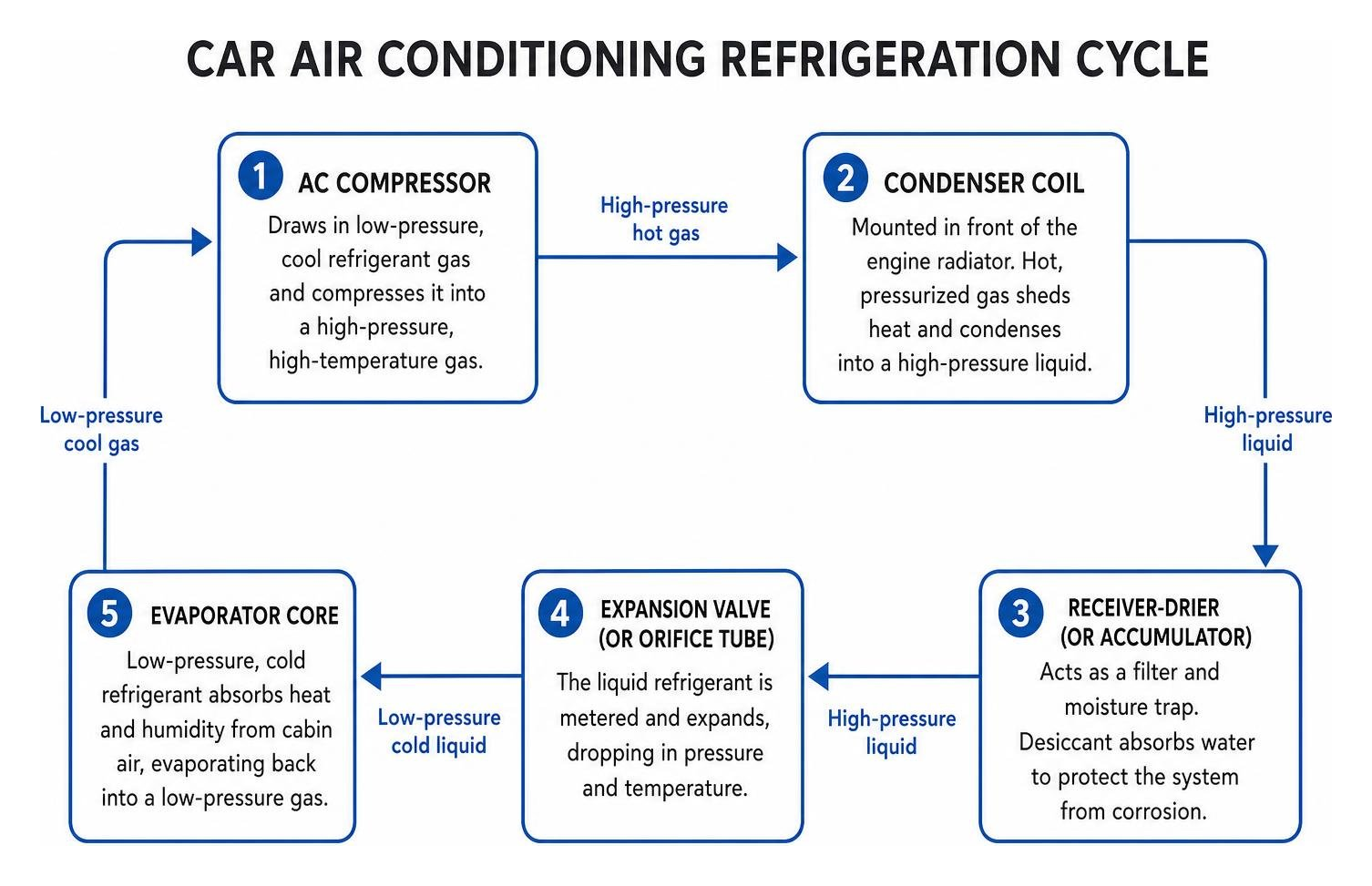
The automotive climate control loop operates through five interconnected mechanical and thermal components:
- The AC Compressor: Often called the heart of the system, the compressor is driven by the engine's serpentine belt. It draws in low-pressure, cool refrigerant gas from the cabin and compresses it into a high-pressure, high-temperature gas, forcing it toward the front of the vehicle.
- The Condenser Coil: Mounted directly in front of the vehicle's engine radiator, the condenser acts like a mini-radiator. As ambient air flows through its fins (assisted by electric cooling fans), the hot, pressurized gas sheds its heat and condenses into a high-pressure liquid.
- The Receiver-Drier (or Accumulator): This component acts as a safety filter and moisture trap. It contains desiccant material that absorbs trace water molecules. If moisture mixes with refrigerant and circulating compressor oil, it forms corrosive acids that eat through metal lines and degrade rubber seals.
- The Thermal Expansion Valve (or Orifice Tube): Acting as a precision metering gate, this valve suddenly restricts refrigerant flow, dropping the high pressure down into a low-pressure mist. This rapid pressure drop causes the liquid's temperature to plummet instantly.
- The Evaporator Core: Tucked deep inside the dashboard within the HVAC air handler box, the freezing-cold evaporator core absorbs thermal energy from the interior cabin air.
- The Blower Motor: A high-speed cabin fan pulls warm, humid air across the chilled evaporator fins. Moisture in the air condenses on the cold metal surface and drains out through a tube beneath the car, while crisp, dehumidified air blows through your dashboard vents.
Just as residential systems require balanced airflow and precise refrigerant levels, as seen in specialized Quincy, FL HVAC Services, automotive systems demand exact pressures to protect mechanical parts while operating in extreme, fluctuating road conditions.
When to Schedule Automotive Air Conditioning Repair: Key Warning Signs
Automotive AC problems rarely appear overnight without warning. Catching minor performance drops early protects critical components—especially the expensive compressor—from catastrophic internal failure.
If you notice any of these symptoms while driving in North Florida, schedule a professional inspection:
- Warm or Luke-Warm Airflow: If the air coming from your dash registers never turns crisp and cold, or if cooling takes fifteen minutes to begin, your system likely has low refrigerant or an internal valve restriction.
- Cooling Loss While Idling: If your vents blow cold while cruising down Capital Circle or I-10, but turn warm when you stop at a red light or sit in traffic, you may have failing electric condenser fans or low system pressure.
- Strange Rattles, Grinding, or Squeals: Squealing upon switching the AC on points to a loose or glazed drive belt. Grinding, clicking, or rattling sounds coming from the engine bay often indicate that the compressor's internal bearings or electromagnetic clutch are failing.
- Persistent Mildew or Musty Smells: Stagnant water and fungal spores can build up on a damp evaporator core, creating foul odors whenever the blower runs.
- Excessive In-Cabin Humidity: If your windows fog up when you run the defroster or the interior air feels swampy and heavy, your evaporator is failing to dehumidify incoming air.
- Water Leaking Onto the Passenger Footwell: When the evaporator drain tube gets clogged by debris, road grime, or algae, condensed water backs up and spills onto your interior carpet, damaging electronic modules and padding.
Professional AC Diagnostics vs. Quick Freon Recharges
One of the most persistent misconceptions in car care is that refrigerant is a consumable fluid—like engine oil or washer fluid—that naturally disappears over time. In reality, automotive air conditioning is a hermetically sealed, closed-loop system. Refrigerant never burns up or wears out. If your vehicle is low on charge, it has an active physical breach.
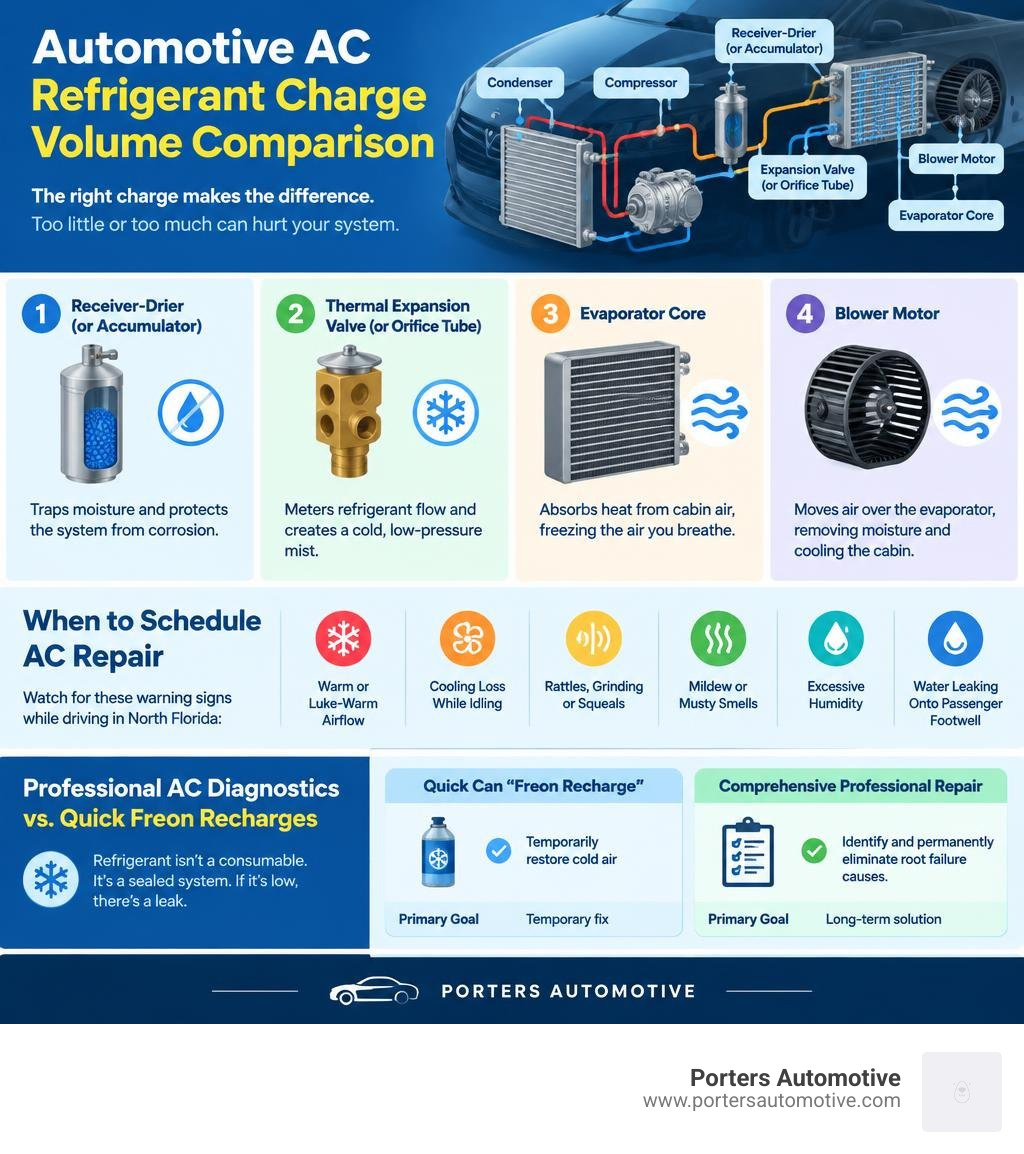
A comprehensive professional diagnosis identifies why the charge dropped, rather than temporarily masking the problem.
| Diagnostic / Service Step | Quick Can "Freon Recharge" | Comprehensive Professional Repair |
|---|---|---|
| Primary Goal | Temporarily restore cold air | Identify and permanently eliminate root failure causes |
| Leak Detection | None performed | Electronic sniffers, UV dye injection, and vacuum decay testing |
| System Pressure Analysis | Basic, low-side single gauge reading | Dual-manifold dynamic testing (high and low side pressures) |
| Moisture & Contaminant Removal | Traps air and moisture inside lines | Deep vacuum evacuation boil-off down to 500 microns |
| Compressor Lubricant Check | Guesses or ignores oil balance | Replaces exact PAG/POE oil volume lost during leaks |
| Mechanical Component Testing | None | Checks expansion valve, clutch clearance, and cooling fans |
| Warranty Protection | No warranty on parts or performance | Full parts and labor warranty protection |
During a complete diagnostic visit, technicians connect specialized recovery equipment to pull out any remaining refrigerant and measure its exact weight. They then pull the system into a deep vacuum. If the system cannot hold a vacuum, an active leak is confirmed. Technicians pinpoint micro-leaks using electronic halogen sniffers and fluorescent ultraviolet (UV) dyes that glow brightly under UV light along fittings, hose crimps, and the condenser core.
Why DIY Recharges Fail Without Automotive Air Conditioning Repair
Off-the-shelf retail recharge canisters with built-in plastic gauges are widely sold, but they frequently cause more harm than good:
- Overpressurization Risks: Retail cans only connect to the low-pressure service port. Without monitoring the high-pressure side, it is easy to overcharge the system. Excessive pressure creates massive mechanical strain on the compressor, potentially blowing out internal reed valves or cracking aluminum housings.
- Harmful Seal-Swell Additives: Many DIY cans contain chemical "stop-leak" agents. These compounds react with moisture and air, turning into a sticky sludge inside your lines that permanently clogs the tiny passages in your expansion valve, evaporator, and recovery equipment.
- Moisture Damage: Adding refrigerant to a leaking system introduces ambient humidity. Water reacts with circulating PAG oil to produce corrosive hydrochloric and hydrofluoric acids that eat the system from the inside out.
How to Pick the Right Specialist for Your Vehicle
Air conditioning repairs require specialized equipment, environmental certifications, and deep electrical knowledge. When selecting a repair shop, look for specific credentials and standards that ensure lasting quality:
- ASE-Certified Technicians: Look for technicians certified in Automotive Service Excellence (ASE), specifically holding A7 (Heating and Air Conditioning) credentials and Section 609 EPA certification for safe, legal refrigerant recovery and handling.
- Comprehensive Parts and Labor Warranties: A reputable repair facility stands behind its workmanship. Look for shops that provide extensive warranties—such as 24-month/24,000-mile or 36-month/36,000-mile coverage on replaced compressors, condensers, and lines.
- Advanced Digital Scan Tools: Modern dual-zone climate systems rely on cabin temperature sensors, sun-load sensors, ambient air thermistors, and electronic blend door actuators. A qualified specialist uses professional diagnostic scan tools to communicate directly with your climate control module.
- System Evacuation Equipment: Shops should use dedicated recovery and charging stations capable of handling both traditional R-134a systems and modern R-1234yf refrigerants without cross-contamination.
Choosing a Full-Service Facility for Automotive Air Conditioning Repair
While dedicated AC specialty shops exist, choosing an established full-service auto repair center often delivers better long-term reliability. Your climate control system does not run in isolation; it works in tandem with your engine cooling system, accessory belt drive, and vehicle electrical architecture.
A full-service shop evaluates every connected system during your visit:
- Engine Cooling System Interdependence: A failing radiator or weak water pump elevates engine bay temperatures, spiking AC head pressures and causing your AC to blow warm air.
- Accessory Drive Belts & Tensioners: Belt slippage under heavy compressor loads leads to charging issues, premature alternator wear, and poor cooling output.
- Electrical Charging Stability: Automotive AC clutches and high-output blower fans place significant demands on your vehicle's alternator and battery.
At Porters Automotive, we handle everything from basic seasonal checkups to complex climate control overhauls, ensuring your entire vehicle runs smoothly and reliably.
Frequently Asked Questions About Automotive AC Service
How often should a car's AC system be serviced?
We recommend scheduling a complete climate control inspection once every year, ideally in the spring before peak summer heat arrives. An annual service includes testing vent discharge temperatures, inspecting cabin air filters, checking drive belt tension, clearing condenser debris, and verifying that cooling fans engage properly.
Why is my car blowing hot air after adding refrigerant?
If you or a shop added refrigerant and the vents still blow warm air, several root issues could be responsible:
- Severe Leak: The added gas may have escaped immediately through a ruptured hose, cracked condenser tube, or failed compressor shaft seal.
- Defective Blend Door Actuator: The AC lines under the hood may be freezing cold, but a broken blend door motor behind the dash can trap your HVAC system on the full-heat setting.
- Compressor Clutch Failure: If the electrical coil, relay, or pressure switch fails, the compressor clutch will not engage to circulate the refrigerant.
- System Overcharge: Adding too much refrigerant triggers high-pressure safety switches, shutting off the compressor completely to prevent the lines from bursting.
Does running the AC significantly reduce fuel economy?
Running your AC does place mechanical load on the engine, but running a properly maintained system has a minimal impact on modern vehicles. In fact, driving at highway speeds with your windows rolled down creates aerodynamic drag that often burns more fuel than operating the climate control. However, an unmaintained, partially seized compressor or an overcharged system forces the engine to work significantly harder, noticeably decreasing your miles per gallon.
Keep Your Vehicle Cool and Reliable
A working air conditioning system is essential for comfortable, safe, and stress-free driving. Ignoring warning signs like warm air, strange rattles, or musty smells will only lead to bigger problems and more expensive repairs down the road.
Schedule your annual AC inspection or diagnostic check with our certified team at Porters Automotive. We provide complete automotive air conditioning repair, accurate leak diagnostics, and comprehensive vehicle care to keep you driving comfortably across Tallahassee, Bradfordville, and Quincy all year long.